

Natural rubber is still mixed, in a great many plants, to a clock time or to a dump temperature. Both methods are familiar, and both can produce an acceptable batch on a good day. The difficulty is that NR does not give you the same day twice. Incoming Mooney viscosity varies from lot to lot, mastication is highly sensitive to shear and temperature, and the mixer itself is not a constant machine: rotor speed, cooling-water temperature and flow, fill factor and ram behaviour all drift. When those inputs move, a fixed time or a fixed dump temperature no longer means the same amount of work has been done on the rubber. The result shows up later as scatter in Mooney viscosity, Mooney scorch and the rheometer curve — and as scrap that is hard to explain.
The more reliable process variable is the energy actually delivered to the batch: the specific mixing energy.
Why time-only and temperature-only control fail for NR
Time-only control assumes that every minute in the mixer does the same work. It does not. The instantaneous power drawn by the rotors depends on the viscosity of the batch at that moment, the fill factor, the ram pressure, the rotor speed and how well the chamber is being cooled. A lot of NR that arrives with a higher Mooney viscosity will draw more power and break down differently from a softer lot mixed for the same number of minutes. A mixer that has been running all morning, with warmer cooling water or a warmer chamber, will not put the same shear history into the rubber as the first batch of the shift. Rotor-speed droop under load, a partially blocked cooling passage, or a change in batch weight has the same effect: the clock is the same, the work is not.
NR is particularly unforgiving here because mastication — the deliberate reduction of molecular weight that makes the rubber processable — is sensitive to both mechanical shear and temperature, and, in many shops, to the presence of a peptiser. Two batches given the same mix time can leave the mixer at quite different viscosities.
Temperature-only control looks more scientific, because dump temperature is at least a measurement on the rubber. It is still not enough. Dump temperature is the result of a balance between viscous heating and cooling, not a direct measure of the work done. If cooling is poor, the batch can reach the dump temperature after relatively little mixing: fillers may be incorporated but not well dispersed, and the Mooney may still be high. If cooling is aggressive, or the fill factor is lower than intended, the same dump temperature may be reached only after a great deal of extra work: the rubber is over-masticated, the viscosity falls too far, and a later productive mix may be short on scorch safety. Thermocouple lag, and the difference between a local reading and the bulk temperature, add further uncertainty.
Time and temperature remain useful as guard bands. They should not be the primary set-point for NR mixing.
How specific mixing energy is calculated
The energy delivered to the batch is obtained by integrating the mixer power over the mix cycle:
E = ∫ P(t) dt
where:
- E is the mixing energy, usually expressed in kWh (or in kJ / MJ);
- P(t) is the instantaneous power at time t, in kW;
- t is time, in hours if E is in kWh (or in seconds, with the appropriate conversion).
The quantity that should be compared from batch to batch, and from mixer to mixer, is the specific energy — energy per unit mass, or sometimes per unit volume:
Eₛ = (1/m) ∫ P(t) dt (kWh/kg)
or, on a volumetric basis,
Eᵥ = (1/V) ∫ P(t) dt (MJ/m³)
where:
- Eₛ is the specific mixing energy (kWh/kg);
- m is the batch mass (kg);
- Eᵥ is the unit work, or volumetric specific energy (MJ/m³);
- V is the batch volume (m³).
If the mixer records rotor torque rather than electrical power, the mechanical power is:
P = τ · ω
where τ is torque (N·m) and ω is the angular speed of the rotor (rad/s). For a two-rotor internal mixer the contributions of both rotors must be included, or — more commonly — the main-motor power, which already drives both, is used.
A practical point that is often missed: use net mixing power wherever the control system allows it. That means subtracting the no-load (idling) power of the motor, gearbox and rotors from the gross motor power, so that E reflects work done on the rubber rather than machine losses. Gross power can still be used for a relative batch-to-batch check on the same mixer, but it is a poor basis for transferring a procedure from one machine to another.
Modern internal-mixer controllers can display the running integral of power and dump the batch at a target Eₛ. Older machines can be treated in the same way if power (or kWh) is logged against time and the integral is calculated after each batch — and then used to adjust the procedure.
Illustrative typical industry range only, not laboratory results and not a specification: for many NR masterbatches in an internal mixer, specific energies of the order of a few tenths of a kWh per kilogram (broadly, a range often discussed around 0.2–0.6 kWh/kg, depending on the compound, fill factor, rotor type and whether oil is added in the same pass) are typical. Productive (final) mixes are usually run at a substantially lower specific energy, because the aim is to add curatives without a further large breakdown of the polymer or a scorch penalty. The correct window is the one you establish on your mixer, for your compound, against the Mooney, dispersion and rheometer targets.
Typical energy stages in NR mixing
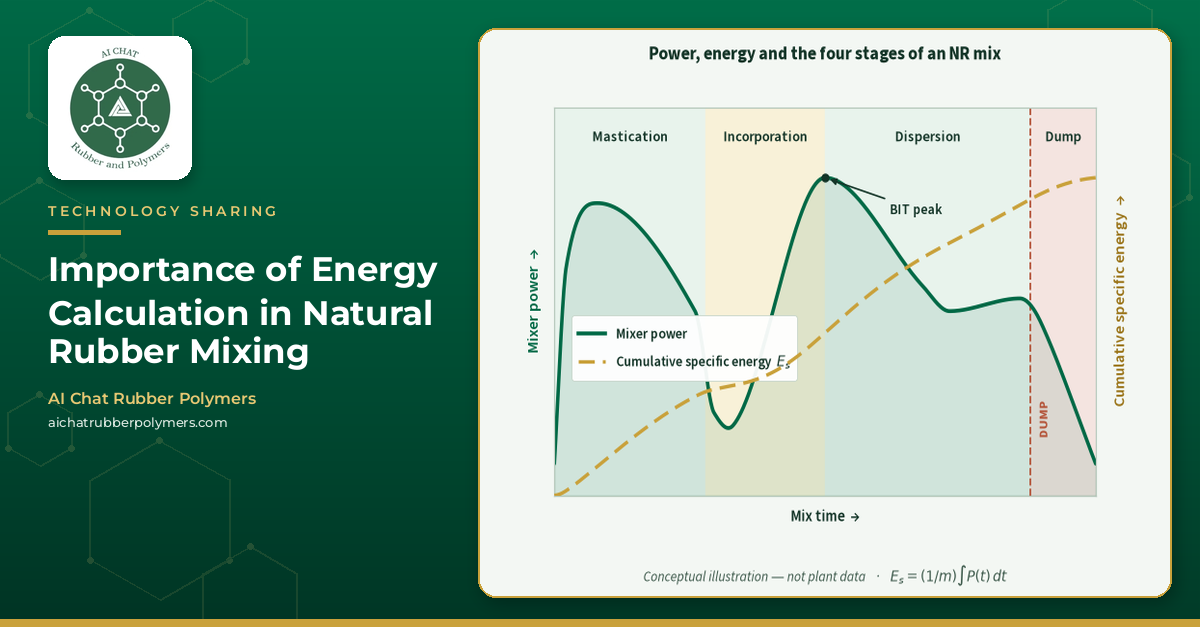
A power–time trace of an NR mix is more informative than a single dump number. In a typical internal-mixer cycle you will usually recognise four stages. The exact shape depends on rotor type, ram, oil addition and whether the mix is a first-pass masterbatch or a final mix; the following is a conceptual description, not a tracing from a particular plant.
1. Mastication / breakdown. NR is charged and the ram is lowered. Power rises as the rubber is sheared, then often declines as molecular weight drops and the batch temperature rises (viscosity falls). This is the stage in which lot-to-lot Mooney variation in the raw rubber is most clearly seen in the power curve. A peptiser, if used, changes both the power level and the energy needed to reach a given viscosity.
2. Filler incorporation. Carbon black or silica is added. Power typically drops briefly while the ram is up, then rises as the filler is taken into the rubber. The classical marker is the black incorporation time (BIT) — the time, and the energy, to the characteristic power peak, or to a defined ram-seating / second-power-peak point, after the filler addition. A late or poorly defined BIT is a warning of incorporation trouble, not something to be hidden by giving the batch “a few more minutes.”
3. Dispersion. After the filler has been incorporated, continued shear breaks down agglomerates. Power often peaks and then declines as the batch becomes more homogeneous and usually hotter. This is where a large part of the remaining specific energy is spent, and where under-mixing (poor dispersion, high residual Mooney, later scatter in tensile, tear and dynamic properties) and over-mixing (unnecessary chain scission, too low a viscosity, possible scorch in a later pass) are both possible.
4. Dump. The batch is dumped at the target specific energy, within an agreed temperature window. The temperature window is a check, not the set-point: if the target energy is reached at a temperature that is unusually high or low, the right response is to ask why (cooling, fill factor, rotor speed, incoming viscosity), not to ignore the energy and chase the thermometer.
Oil or plasticiser, when added in the same pass, produces a characteristic drop in power and must be included in the energy account consistently — the dump target should be defined relative to a clearly stated addition sequence.
A useful shop-floor habit is to archive the power curve, not only the dump energy. The integral tells you how much work was done; the shape tells you how it was done.
What this improves on the shop floor
Once a compound has a qualified specific-energy window (and a dump-temperature guard band), the practical benefits are direct:
- More consistent Mooney viscosity of the dumped masterbatch and of the final compound, because the work done on the NR — not the clock — is being held constant.
- More consistent Mooney scorch and rheometer (MDR/ODR) curves — tₛ2, t₉₀, Mₗ and Mₕ — because viscosity, dispersion and the heat history of the batch are under better control. That, in turn, steadies moulding behaviour and cure in the press.
- Better and more repeatable dispersion, which shows up in tensile, tear, fatigue and dynamic properties, not only in a dispersion rating.
- Lower scrap and fewer “mystery” batches. When a batch is off, the power curve and the energy integral give you something to investigate: incoming NR Mooney, weighment, ram action, cooling water, rotor speed. You are no longer reduced to saying that the mix time was correct.
- Energy and cost. Over-mixing is wasted electricity, wasted mixer occupancy, and often wasted polymer molecular weight. Dumping at a qualified energy, rather than “a little extra to be safe,” cuts that waste. Under-mixing is also a cost, because it returns as remills, rejected parts and customer complaints.
Specific energy is also the most honest starting point when a compound is transferred from a laboratory mixer to the shop, or from one internal mixer to another. It is not a complete scale-up method — rotor geometry, tip clearance, cooling area and ram design still matter — but matching specific energy and fill factor is far more rational than matching minutes.
A practical takeaway for compounders and mixing supervisors
Do not run natural rubber on the clock alone, and do not treat dump temperature as a complete specification.
- Measure (or log) mixer power, and calculate specific energy Eₛ in kWh/kg for every batch.
- Set the dump to a qualified specific-energy window, with dump temperature used as a guard band, not as the primary target.
- Treat the shape of the power curve — mastication, incorporation / BIT, dispersion and dump — as a process signature. A batch that reaches the right energy by the wrong path is still a suspect batch.
- Put incoming NR Mooney viscosity, batch weight (fill factor), rotor speed and cooling-water temperature on the same control plan as the mix procedure. They are inputs to the energy calculation, not background noise.
- Qualify the energy window against the properties that matter: Mooney, Mooney scorch, rheometer curve and dispersion — and only then lock it into the shop standard.
The mixer is doing work on the rubber. If you measure that work, NR mixing becomes a process you can explain, transfer and improve. If you only measure time or temperature, you are trusting the process to be more repeatable than natural rubber really is.