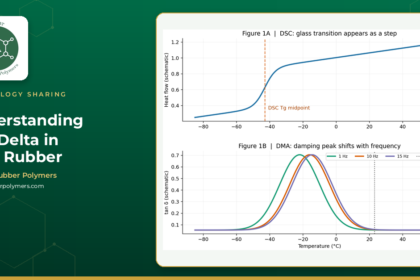
Why do two rubber compounds of the same hardness behave differently under vibration? This practical guide explains tan δ (E″/E′), how DSC, DMA, RPA, and part-level dynamic tests differ, and how polymer, filler, plasticiser, and cure choices balance damping, isolation, and heat build-up in NVH parts.
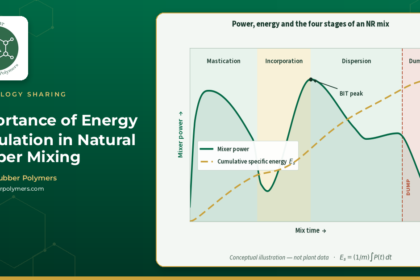
Time or dump temperature alone cannot reliably control natural rubber mixing when Mooney viscosity, rotor speed, and cooling drift. Learn how specific mixing energy (kWh/kg) tracks mastication, filler incorporation, dispersion, and dump stages to steady Mooney, scorch, rheometer curves, scrap, and energy cost.
Introduces NBR (nitrile rubber) and its industrial uses, including belting, hose, gaskets, O-rings, seals, shoe soles and automotive fuel and oil system parts, as the basis for formulating compressed non-asbestos pipeline gaskets, white rice rollers, cork gaskets and oil-resistant high-temperature shoe soles.
NBR formulation guidance for compressed non-asbestos pipeline gaskets, white rice rollers, cork gaskets RC 70-C and oil-resistant, high-temperature shoe soles. Covers NBR applications, the move away from asbestos gaskets, special fillers such as Kevlar, pulp and Rockwool, and polymer blends for oil and gas service.
Overview of thermoplastic elastomers (TPEs), block copolymers with rigid and soft phase-separated domains. Covers methods of synthesis and classification, advantages and disadvantages, mixing, blending and moulding by compression and injection, and industrial applications of TPEs.
Explains solubility parameters (Hildebrand and Scott, δ = ΔE/V) and how they show material compatibility in rubber compounds. Shows how polarity, such as NBR acrylonitrile content, affects swelling and the solubility of sulphur and additives, for controlling blooming and plasticisation in EPDM, NBR, SBR, BR and ACM.